the grammatical gender (solecism) research

Steven Avery

Administrator
Theopneusty: Or, The Plenary Inspiration of the Holy Scriptures (1844)
Louis Gaussen
http://books.google.com/books?id=jS42AAAAMAAJ&pg=PA112

1656176545995.png

1656173932346.png

1656173973309.png

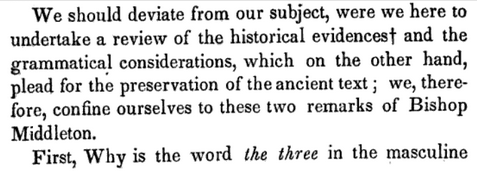
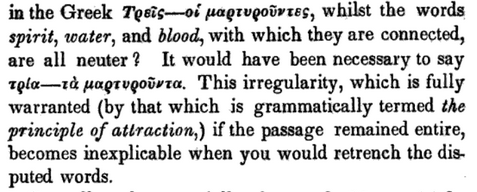
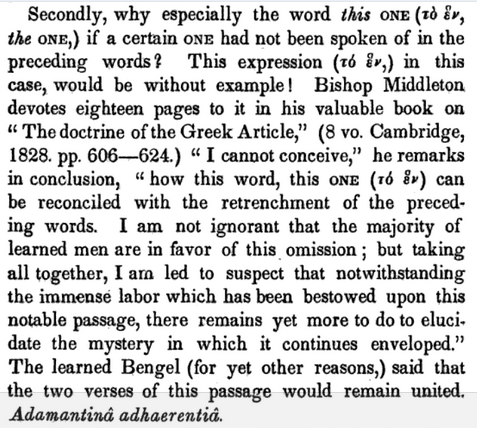
Followed by excellent Middleton section
1656174114633.png

1656174140565.png

Scrivener 1883
1656175445104.png
 
Last edited:

Steven Avery

Administrator
Turretinfan


The Grammatical Argument for the Johannine Comma


" the issue is really about the word μαρτυροῦντες - if that were something other than masculine, both the number and article would surely follow."

Cart before the horse!
  1. Babiniotis does not agree with or accept Voulgaris' linguistic argument, only the conclusion;
  2. Babiniotis thinks that the syntactic parallelism with 5.7 is an adequate explanation for 5.8 having the masculine gender (notwithstanding that it violates the gender agreement rule); and
  3. Babiniotis thinks that if 5.7 needs to be present in order to justify 5.8 on the grounds of syntactic parallelism.

In other words, the big question is why John would refer to the three witnesses using the masculine gender and not using the neuter, even in the absence of 1 John 5:7. There is a better explanation for why John referred to the three witnesses using the masculine gender: although the nouns themselves are not masculine, they are being anthropomorphized as witnesses. An alternative explanation is that although the nouns themselves are not masculine, they are to be understood analogically as referring to the three persons of the Trinity.

....


Assuming that this is indeed John's intent, then the use of the masculine as consistent with treating these witnesses as people.

=====================

Septuagint Joshua 22:34 provides a first example of a non-personal witness:

καὶ ἐπωνόμασεν Ἰησοῦς τὸν βωμὸν τῶν Ρουβην καὶ τῶν Γαδ καὶ τοῦ ἡμίσους φυλῆς Μανασση καὶ εἶπεν ὅτι μαρτύριόν ἐστιν ἀνὰ μέσον αὐτῶν ὅτι κύριος ὁ θεὸς αὐτῶν ἐστιν

Note that altar (βωμὸν) is masculine, but witness (μαρτύριόν) is neuter.

Septuagint Joshua 24:27 provides a second example of a non-personal witness:

καὶ εἶπεν Ἰησοῦς πρὸς τὸν λαόν ἰδοὺ ὁ λίθος οὗτος ἔσται ἐν ὑμῖν εἰς μαρτύριον ὅτι αὐτὸς ἀκήκοεν πάντα τὰ λεχθέντα αὐτῷ ὑπὸ κυρίου ὅ τι ἐλάλησεν πρὸς ἡμᾶς σήμερον καὶ ἔσται οὗτος ἐν ὑμῖν εἰς μαρτύριον ἐπ᾽ ἐσχάτων τῶν ἡμερῶν ἡνίκα ἐὰν ψεύσησθε κυρίῳ τῷ θεῷ μου

Note that stone (λίθος) is masculine but witness (μαρτύριον) is neuter.

 
Last edited:

Steven Avery

Administrator
if the antecedent is the moon, and that is a feminine hebrew word, why is witness (μάρτυς) masculine gender

The discrepancy between the feminine Hebrew word for moon (yareach) and the masculine Greek translation for witness (martys) is explained by a fundamental difference between Hebrew poetic grammar and Greek syntax rules.

1. Hebrew Grammar Allows Mixed Gender in Poetry
In the original Masoretic Text, the word for witness is ‘ed (עֵד), which is a masculine noun. In Hebrew poetry, a masculine noun or participle can be placed in apposition to a feminine noun like yareach (ירח) without requiring grammatical agreement. The moon is the object being described, but "witness" is an independent noun acting as a title or role, which defaults to its natural masculine gender.

2. The Septuagint Follows Greek Syntactical Rules
When the Jewish translators created the Septuagint (LXX), they used the Greek word martys (μάρτυς) for witness.
  • Martys is a masculine/feminine third-declension noun (common gender), but it overwhelmingly defaults to masculine grammatical forms in ancient Greek.
  • In Greek syntax, nouns in apposition (words placed next to each other to define one another) do not have to match the gender of the noun they modify; they only need to match the case (which is nominative here).

3. Alternate Textual Interpretations
Because of this gender mismatch, a minority of biblical scholars and ancient commentators suggested alternative antecedents to avoid the grammatical tension:
  • God as the Witness: Some argue the "faithful witness in the sky" is God Himself, who looks down from heaven to confirm the covenant.
  • The Rainbow: Others link the imagery to the Noahic covenant, where the rainbow (also a masculine noun in Hebrew, qeshet can vary but usually feminine, though the sign concept varies) or the sky itself acts as the witness.
However, the vast majority of modern and ancient scholars agree that the moon is the intended antecedent. The poetic structure of the verse pairs the two lines directly, using the moon's enduring presence in the sky as the visual proof of God's promise.
If you are analyzing the linguistic structure further, would you like to compare how different English translations (like the NRSV, ESV, or JPS) handle this poetic alignment?

=============================

In the Septuagint (the ancient Greek translation of the Old Testament), the Greek word for moon in this passage (found in LXX Psalm 88:38) is σελήνη (selēnē), which is feminine gender. [1, 2]
The Greek text reads:

καὶ ὡς ἡ σελήνη κατηρτισμένη εἰς τὸν αἰῶνα καὶ ὁ μάρτυς ἐν οὐρανῷ πιστός...
(“and as the moon [feminine] established forever, and the witness [masculine] in heaven is faithful...”)
[1, 2]
This creates a striking grammatical feature across both languages:
  • In Hebrew: The word for moon (yareach) is masculine, while the concept or title of "witness" (‘ed) is also masculine. They match perfectly in the original text. [1]
  • In Greek: The translators used selēnē (which is strictly feminine in Greek), but they retained the masculine article and noun for the witness (ὁ μάρτυς). [1, 2, 3]
Because Greek syntax allows a masculine noun in apposition to redefine or give a title to a feminine noun without forcing a gender change, the Greek text successfully preserves the moon as the antecedent while assigning it the masculine role of a formal court "witness". [1]
If you are tracking how these gender shifts impact translation, would you like to see how the Latin Vulgate handles the gender of the moon (luna) and witness (testis) in this same verse? [1]
 

Steven Avery

Administrator
Hi Francis,

"the issue is really about the word μαρτυροῦντες - if that were something other than masculine, both the number and article would surely follow."

This comment has the horse and cart reverses.

The reason μαρτυροῦντες is the masculine form in verse 7 is precisely because two nouns in the heavenly witnesses are masculine. There is no point in theorizing any other gender for the participle than masculine.

The reason μαρτυροῦντες is masculine in verse 8 is the parallelism with verse 7, the two verses connect as one syntactic unit, the grammar is coming forth from the heavenly witnesses.

Blessings and grace in Jesus,
Steven
 
Last edited:
Top