
does animal parchment become brittle over time?

Steven Avery

Administrator
Yes, animal parchment becomes brittle over time, primarily because it is an organic material made of collagen fibers that react to its environment. If the fibers lose too much of their natural moisture, the parchment becomes stiff, hard, and prone to cracking or splitting. [1, 2, 3]


The brittleness is accelerated by several factors: [1] -
  • Low Humidity: Parchment is hygroscopic, meaning it absorbs and releases moisture. If the relative humidity drops below 30–40%, the material dries out, becomes harsh, and can crack.
  • Temperature and UV Light: Heat and direct sunlight can cause physical shrinkage and chemical breakdown of the collagen structure.
  • Oxygen Exposure: Over centuries, oxidation can break down the collagen fibers, leading to a natural hardening of the skin. [1, 2, 3, 4, 5]
How to Prevent Brittleness

To preserve historic or contemporary parchment and keep it flexible, you must store it in a carefully maintained microclimate: [1]
  • Relative Humidity: Maintain a steady 30% to 50% relative humidity. (Dropping below 10-15% will cause irreversible brittleness).
  • Temperature: Keep the storage area between 10°C to 15°C (50°F to 59°F).
  • Display: Limit UV and direct sunlight exposure, and use LED lighting when possible. [1, 2, 3]
For more specific guidance on caring for these materials, consult resources like the Kelsey Conservation Care Guide or the Preservation Self-Assessment Program for best practices. [1, 2]

Could you tell me if you are trying to store an existing artifact or preventatively care for a blank piece of parchment? I can help you tailor your storage methods.
 

Steven Avery

Administrator
Marianne Kelsey
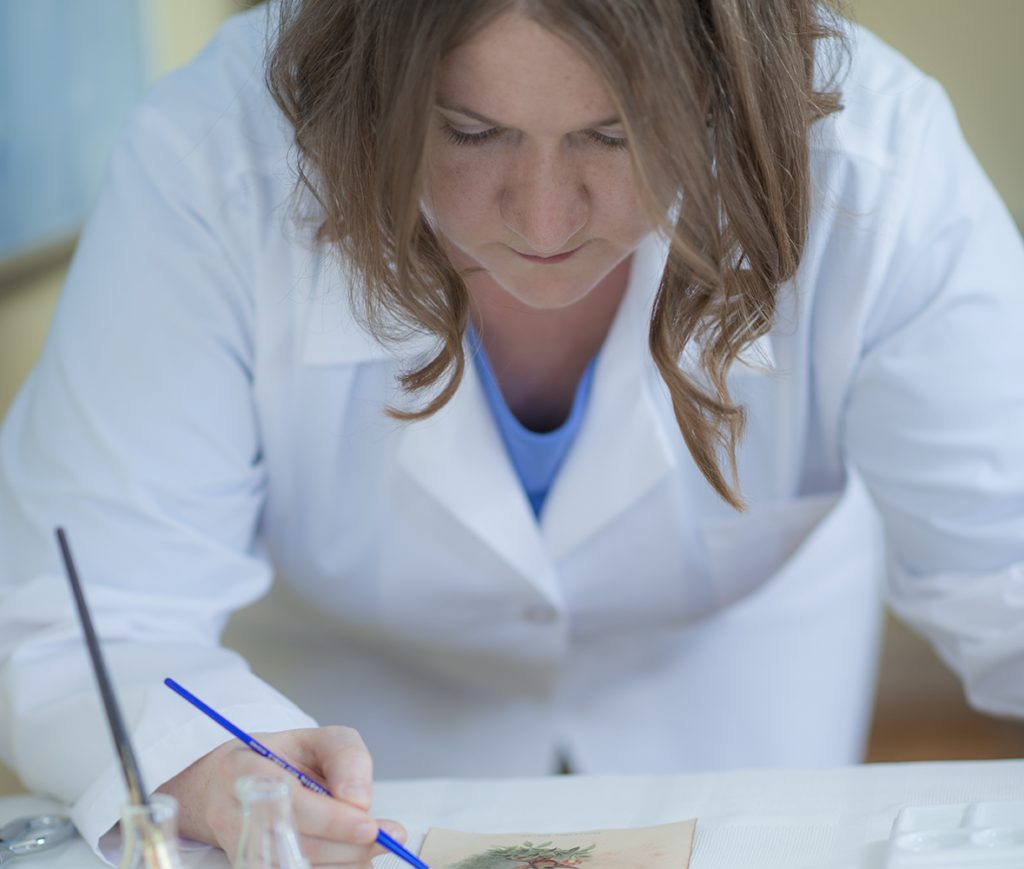
Vellum and Parchment Conservation and Care (2023)
https://kelseyconservation.com/vellum-and-parchment-conservation-care/

Marianne serves as the Director and Senior Conservator of Kelsey Conservation. Kelsey specializes in treating works of art on paper and historical documents. She began her career in conservation in the early 2000’s, and has worked in a variety of conservation labs including the State Historical Society of Iowa’s Conservation Lab, as well as Etherington Conservation Services. In her spare time, Marianne’s passion is dancing. She founded Alegre Latin Dance in Greensboro, a group that offers monthly latin dance socials.

https://alegrelatindancegreensboro.com

Preservation Self-Assessment Program
PSAP
https://psap.library.illinois.edu/collection-id-guide/parchment
 
Last edited:

Steven Avery

Administrator
The History and Technology of Parchment Making
Meliora di Curci

Bibliography
Bykova, G. Z.
(1993). Medieval Painting on Parchment: preservation & restoration. Restaurator, 14(3), 188-197.
Cains, Anthony. (1992). The vellum of the Book of Kells. The Paper Conservator, 16, 50-61.
Cennini, Cennino d'Andrea. (1933). Craftsman's Handbook "Il Libro dell'Atre". Thompson, D. V. (Trans.) New York: Dover. (Original work published 1437)
Clark, Harry. (1979). Special Report: the restoration of manuscripts at EuropeÕs oldest library. Wilson Library Bulletin, 53(9), 620-621.
Gansser, A. (1950). Early History of Tanning. Ciba Review, 81, 2938-2962.
Hunter, Dard. (1943). Papermaking: the history and technique of an ancient craft. New York: Dover Publications.
Kenyon, Frederic G. (1932). Books and Readers in Ancient Greece and Rome. London: Oxford Clarendon Press.
Kireyeva, Vilena. (1999). Examination of Parchment in Byzantine Manuscripts. Restaurator, 20, 39-47.
Reed, Ronald. (1972). Ancient Skins Parchments & Leathers. Leeds: Seminar Press.
Reed, Ronald. (1975). The Nature and Making of Parchment. Leeds: Elmete Press.
Rudin, Bo. (1990). Paper or not? Papyrus, tapa, amate, rice paper and parchment. Making Paper, a look into the history of an ancient craft. Tanner, Roger G. (trans.) Vallingby, Sweden: Rudins, 1-10.
Szczepanowska, Hanna & West Fitzhugh, Elisabeth. (1999). Fourteenth-century documents of the Knights o f St. John of Jerusalem: analysis of inks parchment and seals. Paper Conservator, 23, 36-45.
Wheelock, Mary E. (1928). Paper: its history and development, Chicago: American Library Association.
Woods, Chris.(1995). Conservation Treatments for Parchment Documents. Journal of the Society of Archivists, 16(2), 221-238.
 
Top